
SK hynix Platinum P41
PCIe 4.0 Performance Champion
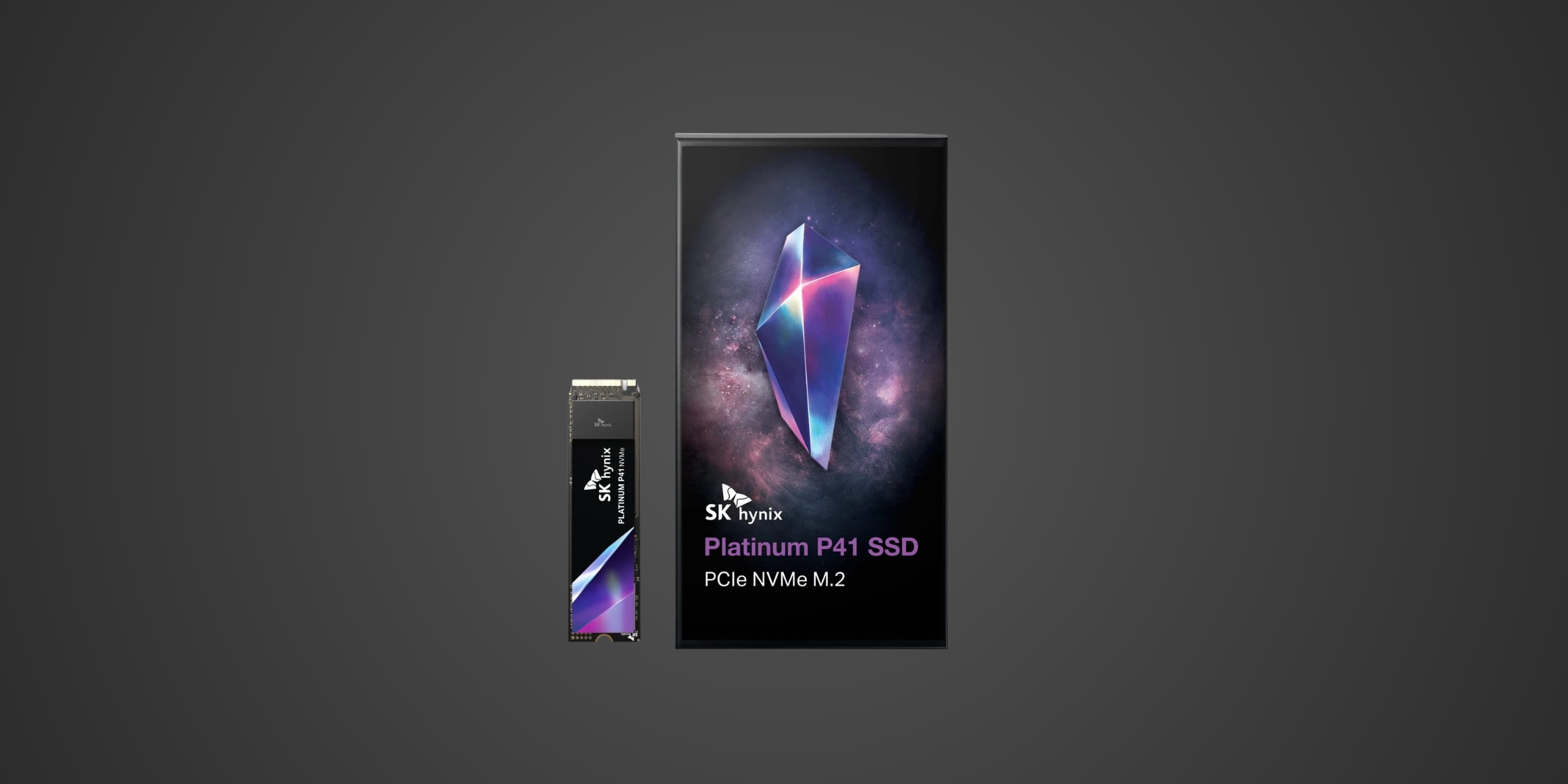
Table of Contents
Introduction
The SK hynix Platinum P41 has arrived as the worthy successor to the beloved Gold P31, bringing top-tier PCIe 4.0 performance to enthusiasts, gamers, and power users who demand the absolute best from their storage. This M.2 NVMe drive targets those upgrading from older SATA or PCIe Gen 3 drives, building new high-performance systems, or expanding PlayStation 5 storage with a drive that delivers flagship-level speeds without the flagship price premium. The P41 sits at the top of the PCIe 4.0 hierarchy, using SK hynix's new Aries controller paired with cutting-edge 176-layer TLC flash to challenge established leaders like the Samsung 980 Pro and WD Black SN850X.
Product Overview
The Platinum P41 comes in the standard M.2 2280 form factor, making it compatible with most modern motherboards and the PlayStation 5's internal expansion slot. SK hynix has equipped this drive with their proprietary eight-channel Aries controller, a significant upgrade from the previous-generation Cepheus found in the Gold P31. This new controller doubles the core count and increases bus speeds by 33%, enabling the drive to reach its impressive performance specifications.
Under the hood, the P41 uses SK hynix's own 176-layer TLC NAND flash with 512Gb dies across all three launch capacities. This newer flash generation offers improved density at 10.8Gb per square millimeter and faster interface speeds of 1600 MT/s compared to the previous generation's 1066 MT/s. The drive also includes SK hynix LPDDR4 DRAM cache, a power-efficient memory solution that stores metadata for faster access to frequently used data. This DRAM presence distinguishes the P41 from budget drives using Host Memory Buffer technology, which borrows system RAM instead.
The Platinum P41 launches in 500GB, 1TB, and 2TB capacities, with the two larger models claiming identical headline speeds of up to 7,000 MB/s sequential read and 6,500 MB/s sequential write. Random performance reaches up to 1.4 million IOPS for reads and 1.3 million IOPS for writes, numbers that exceed virtually every competing PCIe 4.0 drive on the market. The 500GB model sees slightly reduced write performance at 4,700 MB/s, a common characteristic for smaller capacity SSDs with fewer NAND dies to distribute workloads across.
Performance & Real World Speed
The SK hynix Platinum P41 delivers sequential read speeds of up to 7,000 MB/s and sequential write speeds of up to 6,500 MB/s for the 1TB and 2TB models, while the 500GB variant reaches up to 4,700 MB/s writes. These speeds translate to noticeably faster Windows boot times compared to SATA SSDs, with your operating system loading in seconds rather than the minute-plus waits of mechanical drives. Game installations happen remarkably quickly, with modern 100GB+ titles copying to the drive in a fraction of the time required by older storage solutions.
For gamers, the P41 excels at reducing load times between levels and open-world zones. Titles designed to take advantage of DirectStorage API on Windows 11 will benefit from the drive's exceptional random read performance, though these optimizations are still rolling out across the gaming industry. Content creators working with large video projects will appreciate the sustained write speeds, which remain strong even when moving hundreds of gigabytes of 4K footage. The drive's generous SLC cache ensures burst performance stays consistently high for typical workloads.
In real-world testing, the P41 topped 3DMark's Storage Benchmark, which simulates actual gaming scenarios including loading games, saving progress, and recording gameplay. The drive also performed exceptionally well in PCMark 10's mixed workload tests, demonstrating that its speed advantage translates beyond synthetic benchmarks into everyday computing tasks. File copy operations revealed the P41's efficiency, moving 50GB of mixed files faster than most competing drives while maintaining excellent responsiveness during random read and write operations at queue depth one, the metric most relevant to how responsive your system feels during normal use.
Thermal Management
PCIe 4.0 drives generate significantly more heat than their Gen 3 predecessors, and the high-performance P41 is no exception to this reality. During testing, the drive idled comfortably at 40-45°C but climbed past 80°C during extended write workloads that pushed hundreds of gigabytes through the drive continuously. Thermal throttling kicked in around 80°C, though performance remained acceptable at this temperature. More aggressive throttling occurred above 82°C, potentially impacting sustained workloads in poorly ventilated systems or warm environments.
The P41 ships without any integrated heatsink, arriving as a bare drive with simple top and back labels. This design choice keeps costs down and provides maximum flexibility for installation, but it also means you'll need to rely on your motherboard's M.2 heatsink or add an aftermarket cooling solution. Most modern motherboards include M.2 heatsinks that provide adequate cooling for typical use, though enthusiasts pushing the drive hard may want something more substantial. The drive's single-sided design ensures compatibility with most motherboard heatsinks, including lower-profile solutions that might struggle with double-sided drives.
For PlayStation 5 users, a heatsink is absolutely mandatory. Sony requires that any M.2 drive installed in the PS5's internal expansion slot include cooling, and the console will not accept a bare drive. The total height including heatsink must remain under 11.25mm to fit within the console's tight clearances. Aftermarket heatsinks designed specifically for PS5 compatibility are readily available and typically cost between fifteen and thirty dollars. Desktop users in well-ventilated cases may find their motherboard's existing heatsink sufficient, but those in compact systems or warm climates should consider additional cooling to maintain optimal performance and longevity.
Compatibility
The Platinum P41 connects via the PCIe 4.0 x4 interface using the NVMe 1.4 protocol, making it compatible with any motherboard featuring an M.2 slot with key M keying. The drive supports backward compatibility with PCIe 3.0 slots, though you'll be limited to Gen 3 speeds in such configurations. Modern Intel motherboards from 10th generation onwards and AMD motherboards supporting Ryzen 3000 series or newer processors include PCIe 4.0 support. Your motherboard's BIOS must support NVMe booting if you intend to use the drive as your primary operating system disk, though this has been standard on virtually all motherboards manufactured since 2016.
For PlayStation 5 internal expansion, the Platinum P41 meets Sony's official requirements with its 7,000 MB/s read speed exceeding the 5,500 MB/s minimum threshold and its M.2 2280 form factor fitting perfectly in the console's dedicated slot. However, you must add a compatible heatsink before installation, as Sony mandates cooling for all internal expansion drives. The total height including heatsink cannot exceed 11.25mm. Once properly installed with appropriate cooling, the P41 functions identically to the PS5's internal SSD, allowing you to install and play PS5 games directly from the expansion drive without performance compromises.
The drive is explicitly not compatible with Xbox Series X or S internal storage expansion. Microsoft's consoles require proprietary Seagate Storage Expansion Cards for internal storage upgrades, and standard M.2 NVMe drives like the P41 cannot be installed internally. You can use the P41 in an external USB enclosure to store Xbox One games or to archive Xbox Series X/S optimized games, but you cannot play Series X/S optimized titles directly from external storage. This limitation applies to all third-party M.2 drives, not just the P41.
For Windows, macOS, and Linux systems, the P41 works without issue, supporting all major operating systems. Windows users gain full NVMe feature support including TRIM commands for maintaining long-term performance. The drive's AES-256 encryption support works through software rather than requiring specific hardware support, though SK hynix implements TCG Pyrite rather than the more robust OPAL standard. This security implementation suffices for basic encryption needs but lacks the sophisticated features enterprise users might require.
Strengths & Weaknesses
The SK hynix Platinum P41 stands at the pinnacle of PCIe 4.0 performance, delivering class-leading sequential and random speeds that translate into tangible real-world benefits. The drive's 1.4 million IOPS random read capability and 7,000 MB/s sequential read speed make it the fastest consumer PCIe 4.0 SSD tested by Tom's Hardware, outperforming established flagships from Samsung and Western Digital in multiple benchmarks. This performance advantage manifests in faster game loads, quicker file transfers, and more responsive system behavior during demanding workloads. The drive maintains these impressive speeds even during sustained operations, with its generous SLC cache and respectable direct-to-TLC write speeds of around 1,450 MB/s ensuring consistent performance.
Power efficiency represents another significant victory for the P41, which achieves the remarkable feat of delivering flagship performance while consuming less power than competing drives. The drive earned recognition as the most power-efficient PCIe 4.0 SSD in testing, making it an exceptional choice for laptop upgrades where battery life matters. This efficiency stems from both the 12nm Aries controller and the newer 176-layer flash, which requires less power per bit than previous generations. Users upgrading from the beloved Gold P31 can celebrate this efficiency inheritance, as the P41 maintains that drive's battery-friendly characteristics while dramatically increasing performance.
The endurance ratings of 500TBW, 750TBW, and 1,200TBW for the 500GB, 1TB, and 2TB capacities respectively land in the middle of the pack rather than leading it. While these figures prove adequate for typical consumer use where most users will never approach warranty limits, enthusiasts pushing heavy write workloads might prefer drives offering higher endurance specifications. The five-year warranty matches industry standards and provides reasonable protection, though it doesn't extend beyond what competitors offer. The drive's pricing at $104.99, $149.99, and $259.99 MSRP positions it competitively against rivals, particularly at 1TB and 2TB where the price-to-performance ratio shines brightest.
Thermal characteristics present the P41's most significant weakness. The drive runs hot under sustained loads, reaching temperatures exceeding 80°C during extended write operations and requiring throttling to prevent overheating. The absence of any integrated heatsink means users must rely entirely on motherboard cooling solutions or purchase aftermarket heatsinks, adding complexity and potential cost to the installation process. PS5 users face a mandatory heatsink requirement, turning what should be a simple upgrade into a multi-component purchase. Desktop builders with compact cases or inadequate airflow may struggle to keep the drive cool enough for optimal performance, potentially negating some of its speed advantages during extended workloads.
The lack of a 4TB capacity option at launch limits the P41's appeal to users requiring maximum storage in a single drive. While 2TB satisfies most consumers, content creators working with extensive video libraries or enthusiasts maintaining large game collections might wish for higher capacity options. SK hynix's use of 512Gb dies suggests room for a 4TB model eventually, though no such SKU has been announced. Competition from newer PCIe 5.0 drives looms on the horizon, potentially overshadowing the P41's PCIe 4.0 achievements as Gen 5 adoption accelerates. However, Gen 5 drives currently command premium prices and face even more severe thermal challenges, keeping the P41 relevant for price-conscious buyers seeking maximum PCIe 4.0 performance.
Verdict: Should You Buy It?
Buy this if:
- You're building a new gaming PC or workstation and want the fastest PCIe 4.0 drive available
- You're upgrading from a SATA SSD or older PCIe Gen 3 drive and want dramatic performance improvements
- You're expanding your PlayStation 5 storage and can add a compatible heatsink
- You value power efficiency for laptop use without sacrificing performance
- You need exceptional random read/write performance for database work or content creation
- You want class-leading speeds at competitive mid-range pricing
Skip this if:
- You already own a high-end PCIe 4.0 drive like the Samsung 980 Pro or WD SN850X and the upgrade would be marginal
- You need a 4TB capacity drive and cannot wait for potential future releases
- Your system lacks adequate cooling and you're unwilling to add a heatsink
- You require the absolute highest endurance ratings for write-intensive professional workloads
- You can find competing drives on sale that offer similar real-world performance at lower prices
- You're building a PCIe 5.0 platform and want to maximize next-generation interface capabilities