
Satechi Mac Mini M4 Stand & Hub
Solving Apple's Design Puzzles
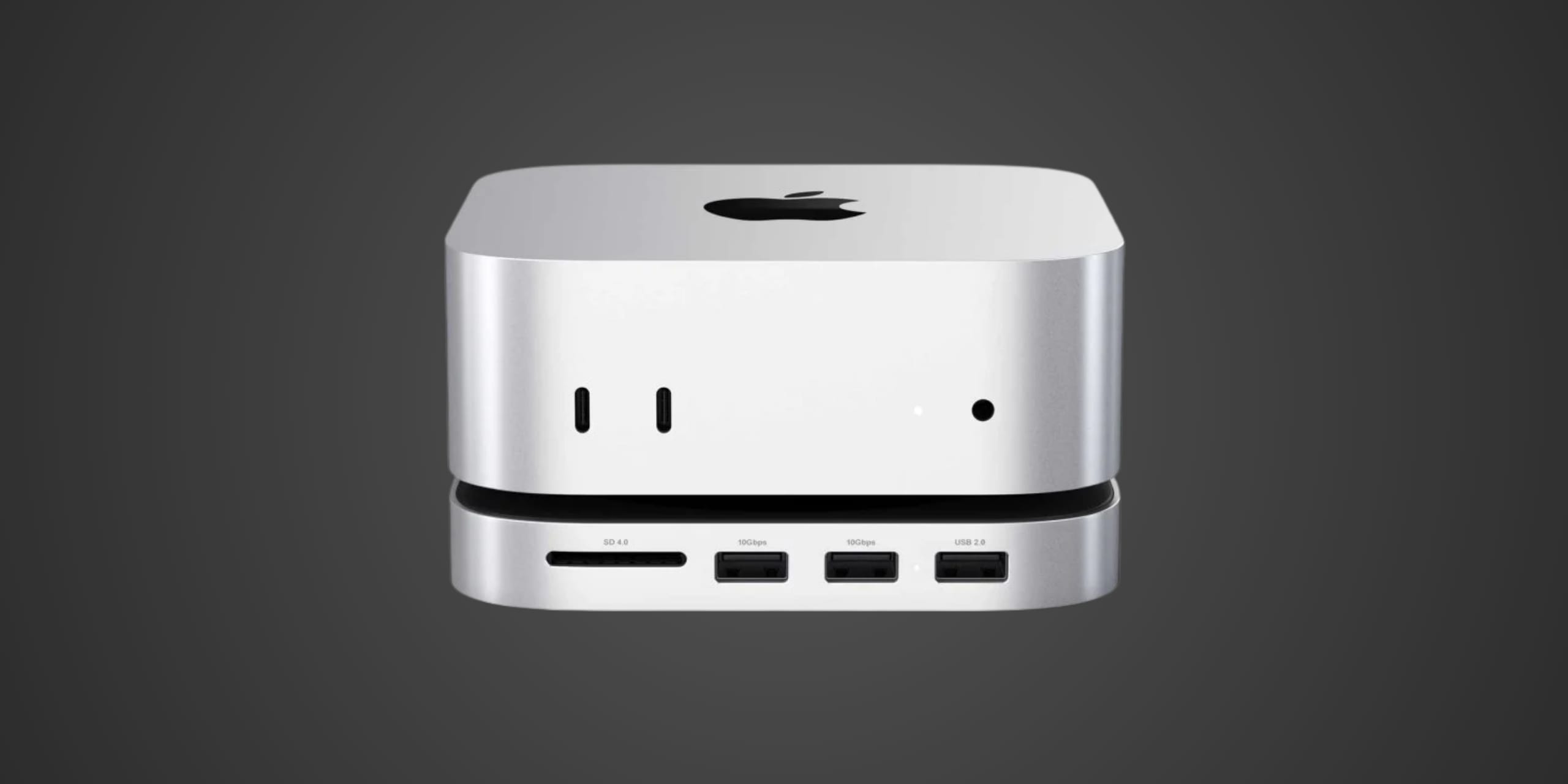
Table of Contents
Introduction
If you own a Mac Mini M4, you've probably already bumped into two glaring frustrations—where the hell did all the USB-A ports go, and why did Apple think putting the power button on the bottom was a good idea? Satechi's Mac Mini M4 Stand & Hub with SSD Enclosure arrives as the accessory maker's answer to these universal annoyances, combining expanded connectivity with internal storage expansion in a package that sits directly underneath your Mac Mini like it was always meant to be there.
This officially licensed accessory breaks the monotony of USB-C-only connectivity by reintroducing legacy USB-A ports alongside an SD card reader, while the integrated M.2 NVMe SSD enclosure supports drives up to 4TB—allowing you to sidestep Apple's astronomical storage upgrade prices that charge $400 for a 1TB bump or a wallet-crushing $800 to reach 2TB. Available now for $99.99, the Satechi hub targets Mac Mini M4 and M4 Pro owners who refuse to pay Apple's premium for internal storage, juggle dongles daily, or perform desktop gymnastics every time they need to turn on their computer.
Product Overview
The Satechi Mac Mini M4 Stand & Hub is built around a USB-C 3.2 Gen 2 connection, which delivers up to 10Gbps transfer speeds through a short integrated cable that plugs directly into one of your Mac Mini's Thunderbolt ports. This isn't just any hub slapped underneath a stand—it's specifically engineered to match the Mac Mini M4's exact 127mm x 127mm footprint and finished in matching silver aluminum that could pass for an Apple product if you squinted hard enough.
Measuring 127mm x 127mm x 20.6mm and weighing approximately 245 grams, the hub adds less than an inch of height to your Mac Mini's desktop footprint while introducing five additional connectivity options. Satechi wraps this functionality in its signature Apple-inspired aesthetic with brushed aluminum construction that's both distinctive and practical—the material serves double duty as a heat sink for the internal SSD enclosure while maintaining the premium feel Mac users expect from their accessories.
The front-facing port array includes two USB-A 3.2 Gen 2 ports rated for 10Gbps transfers, one USB-A 2.0 port for legacy devices at 480Mbps, and a full-size SD 4.0 UHS-II card reader capable of 312MB/s. Around back, you'll find the integrated USB-C host cable and a thoughtfully designed cutout that provides fingertip access to the Mac Mini's otherwise awkwardly positioned power button—no more lifting the computer or sliding it forward on your desk like some kind of elaborate desk-top shuffle.
The internal M.2 NVMe SSD enclosure supports drives in 2230, 2242, 2260, and 2280 form factors with capacities up to 4TB, though Satechi notes the hub has been tested and verified to handle drives up to this size without issues. Critically, this enclosure only works with NVMe M.2 PCIe SSDs—SATA drives are not compatible, and SSDs equipped with heatsinks or double-sided configurations won't fit in the tight internal space. The package includes a thermal pad to help dissipate heat during heavy transfers, a small screwdriver for SSD installation, the necessary mounting screw, and a user manual that walks you through the straightforward installation process.
Satechi backs the hub with a two-year limited warranty covering defects in materials and workmanship under normal use—a confidence signal that suggests this isn't a disposable accessory. The bottom of the hub features strategically placed ventilation slots that work in concert with the recessed top surface to ensure efficient airflow around your Mac Mini's bottom-mounted intake vents, maintaining proper thermal management even when you're hammering both the hub's ports and the internal SSD simultaneously.
Performance & Real World Speed
Satechi claims the USB-A 3.2 Gen 2 ports deliver up to 10Gbps transfer speeds, with the manufacturer specifically highlighting their marketing example of transferring 3,000 high-resolution images in just one minute. The SD card reader operates at up to 312MB/s through its UHS-II interface, while the internal NVMe enclosure maxes out at 10Gbps through the USB 3.2 Gen 2 connection.
Here's where the math gets interesting and slightly disappointing—while the Mac Mini M4's Thunderbolt 4 ports theoretically support 40Gbps bandwidth, the hub itself bottlenecks everything at the USB 3.2 Gen 2 specification of 10Gbps, which translates to approximately 1,250MB/s in real-world megabytes per second. Multiple reviewers testing the hub with various NVMe SSDs consistently reported actual transfer speeds hovering around 1,000MB/s to 1,100MB/s, which aligns perfectly with USB 3.2 Gen 2 limitations rather than Thunderbolt's capabilities.
In real-world testing conducted by multiple reviewers, a Crucial 1TB NVMe drive rated for 7,100MB/s theoretical speeds achieved approximately 1,000MB/s through the Satechi hub's enclosure when tested with BlackMagic Disk Speed Test. This performance sits comfortably between the Mac Mini M4's sluggish 256GB base SSD—which delivers around 2,000MB/s write and 2,800MB/s read—and faster external Thunderbolt 4 enclosures that can push beyond 3,000MB/s. The hub essentially splits the difference, offering speeds that feel snappy for everyday tasks like launching applications, storing project files, or serving as a Time Machine backup destination, but falling short of what's possible if you invested in a dedicated Thunderbolt 4 NVMe enclosure.
The USB-A data ports performed as advertised in testing, sustaining the full 10Gbps spec when transferring large files to compatible drives. The SD card reader similarly hit its 312MB/s ceiling when tested with fast UHS-II cards, making it perfectly adequate for photographers and videographers who need to offload camera footage quickly. However, it's worth noting that the USB-A 2.0 port's 480Mbps speed is strictly for legacy devices—think older peripherals, keyboards, or wireless dongles that don't need high-speed data transfer.
The hub operates as a bus-powered device, drawing all its power directly from the Mac Mini's Thunderbolt port without requiring an external power supply. Satechi recommends connecting only one bus-powered device at a time to avoid potential power delivery issues, and the USB-A ports explicitly will not charge iPads or support certain power-hungry devices like Apple's SuperDrive optical drive. In practice, this means you'll want to avoid plugging in multiple external SSDs simultaneously unless they have their own power supplies, but for typical keyboard-mouse-thumb-drive usage, the hub handles power distribution without complaint.
Build Quality & Durability
Satechi has built a reputation for creating Apple-adjacent accessories that look like they could have rolled off the same assembly line as the products they complement, and the Mac Mini M4 Stand & Hub continues this tradition with impressive execution. The all-aluminum construction feels substantial without being heavy—that 245-gram weight provides just enough heft to prevent the hub from sliding around when you're inserting SD cards or plugging in USB devices, while the brushed finish precisely matches Apple's silver Mac Mini aesthetic.
The manufacturing tolerances are tight enough that the Mac Mini sits flush on the hub's recessed top surface without any wobble or play, creating what appears to be a single unified device from most viewing angles. Small rubber risers elevate the Mac Mini approximately 6mm off the hub's plastic top panel—a critical design decision that preserves WiFi and Bluetooth signal integrity since the Mac Mini M4 positions its antennas on the bottom of the chassis. Some competing hubs feature solid metal tops that block wireless signals, but Satechi avoided this trap with a plastic top panel that maintains connectivity while still looking cohesive with the aluminum sides.
The front-facing ports feature clean machining with no rough edges or misaligned cutouts, and the SD card slot includes a spring-loaded mechanism that provides satisfying tactile feedback when inserting and ejecting cards. Reviewers consistently praised the build quality, noting that nothing feels cheap or flimsy despite the sub-$100 price point. The integrated USB-C cable measures approximately 80mm in length with a braided fabric sleeve that adds durability and a premium touch, though its short length means you'll need to position the hub directly beneath your Mac Mini rather than off to the side.
The rear power button cutout demonstrates thoughtful industrial design—it's positioned precisely where your finger naturally wants to reach, with enough clearance that you can press the Mac Mini's button without having to lift or adjust the computer. This seemingly minor feature solves one of the Mac Mini M4's most criticized design decisions and transforms a daily annoyance into a non-issue. The cutout is large enough to accommodate different finger sizes and approach angles, and the hub's stable base means you're not fighting shifting hardware when you press down.
Interior components include bottom ventilation slots that feel substantial rather than decorative, with enough open area to promote genuine airflow rather than just looking the part. The thermal pad included for the SSD installation indicates Satechi took heat management seriously during design, recognizing that cramming an NVMe drive into a tight enclosure without adequate cooling would lead to thermal throttling and degraded performance over time. While the hub does get warm during heavy SSD usage—you can feel heat rising from the bottom vents—it never reaches uncomfortable temperatures that suggest thermal issues.
The two-year warranty provides additional peace of mind, though it's worth noting that any issues with a user-installed SSD would need to be diagnosed separately from the hub itself. Satechi's customer support receives generally positive marks from users, and the company maintains detailed FAQ documentation and installation guides on their website for troubleshooting common issues.
Compatibility
The Satechi Mac Mini M4 Stand & Hub is specifically and exclusively designed for the 2024 Mac Mini M4 and Mac Mini M4 Pro. This is purpose-built hardware that only works with these exact models, period. The hub is absolutely not compatible with older Mac Mini generations from 2018 through 2023—the footprint doesn't match, the port layout differs, and you'll have a physically incompatible product if you try to use it with earlier models.
Installation requires nothing more than unboxing the hub, connecting its USB-C cable to any Thunderbolt port on the rear of your Mac Mini, and placing the computer on top. The Mac automatically recognizes the hub's USB ports and SD card reader immediately without any driver installation or configuration. If you're adding an NVMe SSD to the internal enclosure, you'll need a small Torx screwdriver to access the drive bay on the bottom of the hub—Satechi includes the correct tool along with a thermal pad and mounting screw, so you won't need to scramble for additional hardware.
Here's what the Satechi hub CAN do—it expands your Mac Mini M4's connectivity with three additional USB-A ports that work with essentially any USB device you'd normally connect to a computer, from external hard drives to keyboards to wireless peripheral dongles. The SD card reader handles full-size SD, SDHC, and SDXC cards at UHS-II speeds, making it ideal for photographers and videographers who need to transfer camera footage. The internal NVMe enclosure turns any compatible M.2 drive into seamless additional storage that appears on your Mac desktop as a standard external volume, perfect for storing large media libraries, serving as a Time Machine backup destination, or housing project files that don't need to live on your primary boot drive.
Critically, you need to understand what this hub cannot do. The USB-A ports will not charge iPads—they provide data connectivity but insufficient power for Apple's tablets. The ports do not support CD readers including Apple's own SuperDrive optical drive, likely due to the power requirements exceeding what the bus-powered hub can deliver. Satechi explicitly recommends connecting only one bus-powered device at a time to avoid overwhelming the hub's power budget, which means you'll need to be thoughtful about what you plug in simultaneously. Multiple unpowered external SSDs pulling power through the hub could lead to disconnection issues or reduced performance.
The internal SSD enclosure supports only NVMe M.2 PCIe solid state drives—SATA-based M.2 drives will not work even though they use the same physical connector. SSDs equipped with heatsinks are incompatible because they won't fit in the tight internal space, and double-sided drives with memory chips on both sides of the circuit board similarly won't work. If you're purchasing a drive specifically for this hub, verify it's single-sided NVMe with no attached heatsink, or plan to remove any heatsink before installation.
The hub connects via USB 3.2 Gen 2 specification, which means you're capped at 10Gbps bandwidth regardless of whether you're using it with the base Mac Mini M4's Thunderbolt 4 ports or the Mac Mini M4 Pro's faster Thunderbolt 5 ports. You cannot achieve Thunderbolt-level transfer speeds through this hub—the controller simply doesn't support it. If you need true 40Gbps Thunderbolt 4 speeds for your external storage, you'll need to invest in a proper Thunderbolt enclosure, which starts around $138 for just the enclosure before adding an SSD.
Strengths & Weaknesses
The Satechi Mac Mini M4 Stand & Hub's greatest strength lies in solving multiple Mac Mini frustrations simultaneously without breaking the bank. For $99.99, you're getting expanded connectivity that reintroduces USB-A ports Apple eliminated, an SD card reader that photographers and content creators actually use, storage expansion capability up to 4TB, and convenient access to the otherwise awkward power button—all while maintaining the Mac Mini's compact desktop footprint and premium aesthetic. This comprehensive approach to addressing real-world pain points demonstrates Satechi actually talked to Mac Mini users rather than just designing a generic hub.
The build quality justifies the price point with aluminum construction that feels premium and durable rather than plastic throwaway garbage you'd expect from budget accessories. The attention to thermal management through bottom vents, a plastic WiFi-transparent top panel, and included thermal pads for SSD installation suggests engineering thought went into this product beyond just checking feature boxes. Transfer speeds through the USB-A ports hit their advertised 10Gbps ceiling, and the SD card reader delivers on its 312MB/s UHS-II promise, making this hub genuinely useful rather than merely decorative.
The plug-and-play nature is beautifully simple—connect one cable, place your Mac Mini on top, and everything just works without driver installation, configuration menus, or troubleshooting. Adding an NVMe drive takes maybe fifteen minutes even if you've never opened an electronics enclosure before, thanks to the included tools and straightforward design. The power button cutout alone justifies the purchase for some users who've grown tired of the daily desk gymnastics required to turn on their Mac Mini, transforming a legitimate ergonomic annoyance into a solved problem.
Storage expansion through the internal NVMe enclosure provides a cost-effective alternative to Apple's predatory upgrade pricing—you can install a quality 1TB NVMe drive for $70 to $100 and achieve decent transfer speeds, versus paying Apple $400 for the same capacity bump. Even a 2TB drive that costs $130 to $180 on the open market saves you $620 compared to Apple's $800 upcharge, making the hub's $99.99 price seem downright reasonable when you factor in the storage savings alone.
However, the Satechi hub isn't without notable limitations. The fundamental weakness affecting this hub and virtually all Mac Mini M4 accessories currently on the market is the bottleneck at USB 3.2 Gen 2 speeds rather than leveraging the Mac Mini's Thunderbolt 4 or Thunderbolt 5 capabilities. You're paying $99.99 for a hub that connects to a 40Gbps port but operates at 10Gbps, effectively wasting 75% of the available bandwidth. For users who specifically bought the Mac Mini M4 Pro with its blazing Thunderbolt 5 ports, this speed restriction feels particularly frustrating—you've got an 80Gbps pipe feeding into what amounts to a 10Gbps garden hose.
Real-world NVMe SSD speeds through the internal enclosure hover around 1,000MB/s to 1,100MB/s, which sounds impressive until you realize modern Thunderbolt 4 enclosures easily exceed 3,000MB/s with the same drives. If you're working with massive video files, large photo libraries, or any workflow where storage speed directly impacts your productivity, the hub's USB 3.2 Gen 2 limitation represents a genuine performance compromise. A standalone Thunderbolt 4 NVMe enclosure costs about $138 without a drive but delivers three times the speed, so value-seekers focused purely on maximum storage performance might find the hub's convenience doesn't justify the speed sacrifice.
The bus-powered design creates practical limitations that reveal themselves in real usage—you cannot reliably run multiple unpowered external SSDs simultaneously, iPad charging doesn't work, optical drives aren't supported, and Satechi explicitly recommends connecting only one bus-powered device at a time. For users expecting this hub to turn their Mac Mini into a connectivity powerhouse that can handle five simultaneous USB peripherals, reality will disappoint. The hub works beautifully for typical keyboard-mouse-thumb-drive usage, but push the power envelope and you'll encounter disconnection issues or devices that simply refuse to work.
The competitive landscape reveals another consideration—this hub's port selection represents trade-offs compared to alternatives from UGREEN, RayCue, IVANKY, and others. Some competitors include HDMI ports for video output, DisplayPort for high-refresh monitors, USB-C data ports alongside USB-A, or microSD card readers in addition to full-size SD slots. The Satechi hub specifically omits video output entirely and includes only USB-A data ports without any USB-C connectivity beyond the host cable. If you need video expansion or prefer USB-C peripherals, you'll find those features on competing products, sometimes at similar or even lower prices.
Verdict: Should You Buy It?
Buy this if:
- You own a Mac Mini M4 or M4 Pro and find yourself regularly frustrated by the lack of USB-A ports for existing peripherals like keyboards, mice, wireless dongles, or thumb drives
- You work with SD cards frequently and want to avoid Apple's astronomical internal storage upgrade pricing by installing your own NVMe drive for a fraction of the cost
- The Mac Mini's bottom-mounted power button drives you crazy and you value a clean desktop aesthetic where the hub visually disappears beneath your Mac
- You need a simple plug-and-play solution that solves multiple problems simultaneously without requiring technical expertise or external power supplies
Skip this if:
- You prioritize absolute maximum storage speed and would rather invest in a dedicated Thunderbolt 4 enclosure that delivers 3,000MB/s+ transfers even though it costs more and takes up separate desk space
- You primarily work with large video files where that threefold speed advantage materially impacts your workflow efficiency
- You need video output expansion through HDMI or DisplayPort which this hub doesn't provide
- Your peripheral ecosystem has fully transitioned to USB-C and you don't actually need USB-A compatibility
- You plan to connect multiple bus-powered devices simultaneously and need more robust power delivery than this hub's bus-powered design can provide
- You own an older Mac Mini from 2018-2023 since this hub is exclusively designed for the 2024 M4 models and won't physically fit earlier generations