
SABRENT PS5 Heatsink
The Cover Replacement That Actually Makes Sense
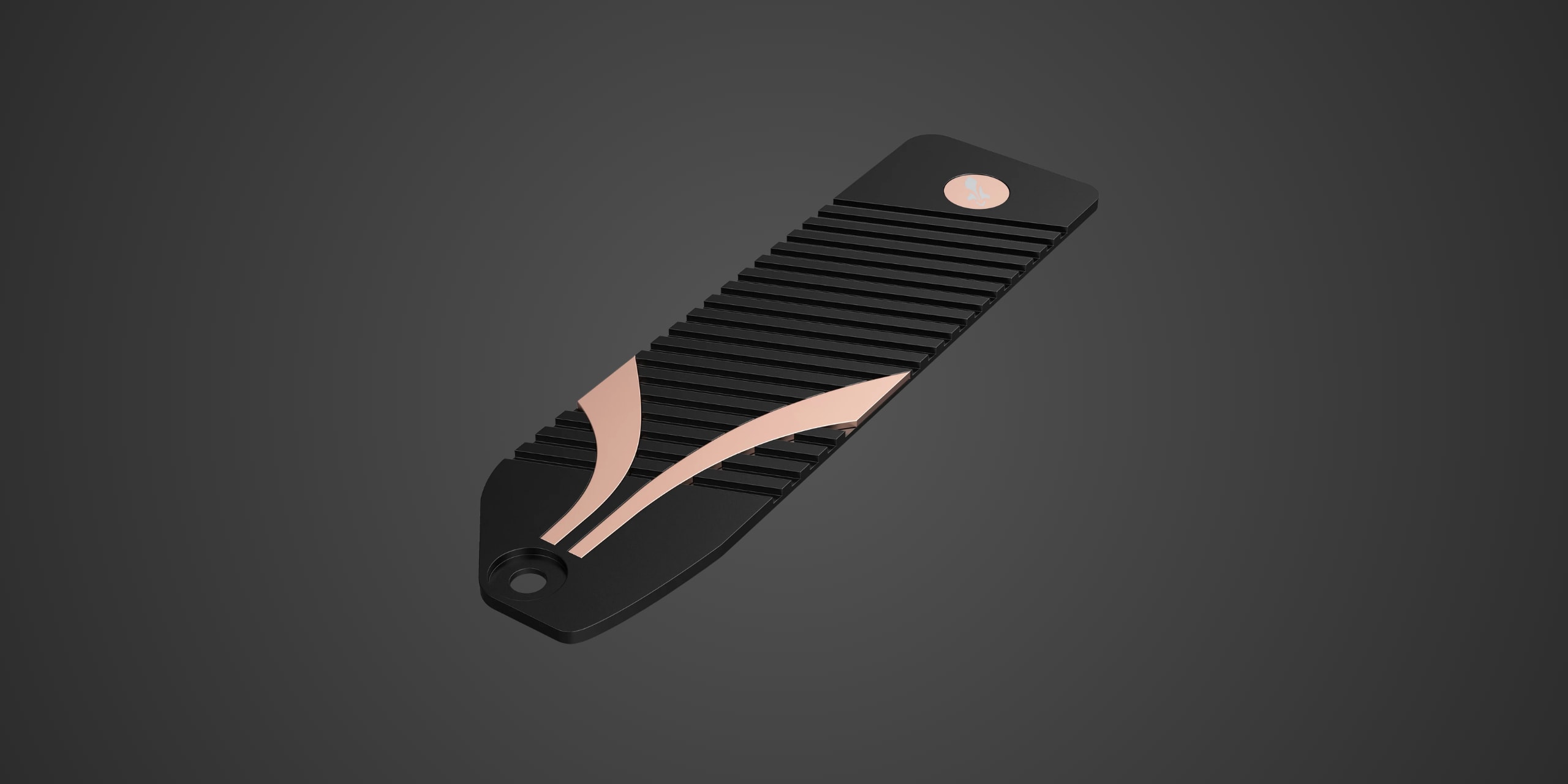
Table of Contents
Introduction
If you own a PlayStation 5 and you've taken the plunge into expanding your storage with an M.2 NVMe SSD, you've probably already bumped into Sony's firm recommendation to use a heatsink. The console's M.2 expansion slot can accommodate PCIe 4.0 drives that push 7,000 MB/s—speeds that generate serious heat—and without proper cooling, thermal throttling will knock your expensive new SSD down to pedestrian performance levels during extended gaming sessions. The aftermarket responded with dozens of adhesive heatsinks, clip-on contraptions, and even elastic band solutions that would make any engineer wince.
Sabrent's PS5 Heatsink arrives as a fundamentally different answer to this universal frustration. Rather than designing yet another heatsink that sits underneath Sony's metal expansion slot cover and traps heat through negative pressure cooling, Sabrent engineered a replacement cover that is the heatsink. This isn't just another aluminum rectangle slapped onto an SSD with thermal tape—it's specifically designed to replace the PS5's native expansion slot cover entirely, creating a larger cooling surface that benefits directly from the console's internal fan airflow. The approach eliminates the cramped installation dance of fitting both a heatsink and the stock cover into Sony's tight expansion bay, and it promises better thermal performance by exposing the heatsink directly to active cooling rather than relying on trapped hot air to eventually dissipate.
Available as a standalone accessory for around $15-20 or bundled with Sabrent's own Rocket 4 Plus SSDs in capacities from 500GB to 8TB, the SB-PSHS targets PS5 owners who refuse to play the constant shuffle game of uninstalling games to make room for new downloads. Competing against stick-on heatsinks that cost $8-12 but deliver questionable thermal contact and traditional heatsinks that require removing pre-attached cooling from compatible SSDs, Sabrent's cover-replacement design positions itself as the practical middle ground—marginally more expensive than basic options but dramatically simpler to install and more effective at sustained cooling.
Product Overview
The Sabrent PS5 Heatsink is built around a single piece of CNC-machined aluminum that measures 125.73mm x 33.02mm x 8.13mm—roughly the size of a Kit Kat bar but about twice as thick. The unit weighs 2 ounces, which translates to 56.7 grams, providing substantial thermal mass without adding meaningful weight to your console. This isn't some stamped sheet metal with fins—Sabrent milled this from solid aluminum stock, giving it the heft and precision you'd expect from industrial-grade computer components.
The design philosophy here breaks from every other PS5 heatsink on the market. Traditional aftermarket heatsinks sit on top of your M.2 drive and hide underneath Sony's expansion bay cover, creating what Sabrent correctly identifies as a thermal trap—the metal cover blocks airflow and forces the heatsink to cool via negative pressure and radiant heat dissipation alone. Sabrent's solution literally replaces that cover with an aluminum heatsink that features Sabrent's signature matte black finish and subtle ridging along the surface. The ridges aren't just aesthetic posturing—they increase surface area for improved heat dissipation and provide texture for grip when inserting or removing the cover from the console's expansion bay slot.
Critically, this replacement cover design leverages what Sabrent calls their "Sandwich Design" thermal architecture. The heatsink sits in direct contact with your M.2 SSD through the included thermal pad, applying even pressure across the entire length of the drive rather than concentrating contact at specific chipset or NAND locations. This uniform pressure distribution matters because M.2 drives generate heat across their entire PCB—the controller, DRAM cache if present, and NAND chips all contribute to thermal load. Inconsistent contact creates hot spots that can trigger localized throttling even if average temperatures look acceptable.
The package includes everything you need for installation—the aluminum heatsink cover itself, a pre-cut thermal pad designed specifically for M.2 2280 drives, mounting screws, and a straightforward installation guide. Sabrent backs the heatsink with a standard one-year warranty, which extends to five years if you register your product within 90 days of purchase through their website. That warranty structure suggests Sabrent expects this to be a set-it-and-forget-it component, which aligns with the PS5 expansion bay's role as semi-permanent storage you rarely access after initial installation.
Thermal Performance & Real World Benefits
Sabrent doesn't publish specific temperature reduction claims for the SB-PSHS, which is refreshingly honest given how thermal performance varies wildly based on the specific SSD you're cooling, ambient room temperature, console placement, and how aggressively your particular games hammer storage. What Sabrent does claim is that their cover-replacement design provides superior cooling compared to traditional under-cover heatsinks by exposing the aluminum directly to the PS5's internal fan airflow rather than relying solely on passive convection.
Tom's Hardware tested the Sabrent heatsink with a Rocket 4 Plus 1TB drive and found the approach works exactly as advertised. The heatsink effectively prevented thermal throttling during sustained gaming sessions, keeping the SSD within optimal operating temperatures even during multi-hour play sessions that would typically trigger throttling on drives with inadequate cooling. More importantly, the installation simplicity meant testers could swap drives and heatsinks for comparative testing without the frustration of adhesive thermal pads that refuse to release cleanly or clips that demand precision alignment.
The real-world benefit here isn't necessarily lower peak temperatures compared to the absolute best stick-on heatsinks—it's consistent thermal performance without the installation headaches. When you're dealing with an M.2 2280 PCIe 4.0 drive pushing 7,000 MB/s read speeds, even minor thermal throttling can knock performance down to 5,000 MB/s or lower, creating perceptible stuttering during asset streaming in games like Spider-Man or Ratchet & Clank that rely heavily on the PS5's SSD architecture. The Sabrent heatsink provides enough cooling headroom to prevent throttling during normal gaming scenarios, which is exactly what PS5 owners need—not benchmark-topping thermal performance, but reliable cooling that lets their expensive SSDs maintain advertised speeds.
The exposed design also means better long-term reliability. Heatsinks that sit underneath the PS5's metal cover operate in an enclosed pocket where heat builds up over time during extended gaming sessions. That trapped heat doesn't just affect SSD performance—it can reduce the lifespan of NAND flash by accelerating wear on individual cells. By replacing the cover entirely and exposing the heatsink to active airflow from the PS5's cooling fan, Sabrent's design ensures continuous heat dissipation rather than letting temperatures creep upward across multi-hour gaming marathons.
Build Quality & Installation Experience
Sabrent's matte black CNC-machined aluminum construction delivers exactly what you'd expect from a company that made its reputation on high-performance storage products. The heatsink feels substantial in hand—this isn't flimsy stamped metal that flexes when you apply pressure. The machining is precise enough that the cover slides into the PS5's expansion bay rails smoothly without binding or requiring force, yet tight enough that there's no rattling or play once installed. The surface finish resists fingerprints and minor scratches better than glossy alternatives, and the subtle ridging adds visual interest to what would otherwise be a generic black rectangle.
Installation is genuinely foolproof, which matters enormously for a consumer electronics product targeting PlayStation owners who may have never opened a computer case. You remove the PS5's white side panel—a process Sony designed to be tool-free—and expose the metal expansion bay cover secured by a single screw. Remove that screw and cover, install your M.2 SSD into the slot, apply the included thermal pad to the drive's top surface, place the Sabrent heatsink cover over the drive, and secure it with the included screw. The entire process takes perhaps five minutes if you're being cautious, and there's virtually no way to mess it up unless you somehow forget to remove the protective film from the thermal pad.
The thermal pad itself deserves specific mention—it's pre-cut to match M.2 2280 drive dimensions, adhesive on both sides for secure contact, and thick enough to accommodate slight variations in SSD component height without creating gaps. Cheaper heatsinks often bundle thermal pads that are too thin, too thick, or require cutting to size, adding unnecessary complexity. Sabrent's pad is exactly what you need, nothing more, and that attention to the complete installation experience shows real product development maturity.
Multiple reviewers noted that the heatsink's exposed design may reduce PS5 fan noise during gaming sessions. The theory is sound—by providing better thermal dissipation for the expansion SSD, the console's thermal management system doesn't need to ramp fan speeds as aggressively to maintain safe operating temperatures. Whether you'll notice quieter operation depends entirely on your room's ambient noise, how close you sit to the console, and your personal sensitivity to fan noise, but any reduction in fan speed extends the lifespan of the PS5's cooling system and reduces power consumption, even if the difference is marginal.
The five-year extended warranty with registration also serves as a confidence signal. Sabrent wouldn't offer five-year coverage on a $20 aluminum heatsink if they expected widespread failures or defects. The warranty primarily protects against manufacturing defects rather than damage from misuse, but it's reassuring to know the company stands behind their thermal engineering claims for the long term.
Compatibility
The Sabrent PS5 Heatsink is specifically and exclusively designed for PlayStation 5 consoles—both the original disc and digital editions, as well as the revised PS5 Slim models. This is a PS5 expansion bay accessory that only works with PS5 expansion bays, period. The heatsink fits any standard M.2 2280 NVMe SSD that meets Sony's requirements for the expansion slot, which means PCIe 4.0 drives in the 250GB to 4TB range with sequential read speeds of at least 5,500 MB/s.
Critically, you need to understand what this heatsink can and cannot do. It works with any compatible M.2 SSD you choose—Samsung 980 Pro, WD_BLACK SN850X, Seagate FireCuda 530, Sabrent's own Rocket 4 Plus, or dozens of other PCIe 4.0 drives. You're not locked into Sabrent's ecosystem, though buying their bundled SSD and heatsink packages does simplify the purchasing decision and often costs less than buying components separately.
The heatsink absolutely cannot be used alongside the PS5's original metal expansion bay cover. This is a replacement cover, not an additional component. Some users initially attempt to install both the heatsink and the stock cover, which physically won't work—the expansion bay isn't deep enough, and forcing the issue will likely damage components. The installation guide makes this clear, but it's worth emphasizing: remove the stock cover entirely and never reinstall it as long as you're using the Sabrent heatsink.
This heatsink is also absolutely not compatible with any other devices. You cannot use this heatsink on a desktop PC motherboard's M.2 slot, a laptop, an external enclosure, or any other system beyond the PS5 expansion bay. The physical mounting mechanism and dimensions are PS5-specific, and attempting to force-fit this onto other hardware will fail at best and damage components at worst.
If you're looking for a universal M.2 heatsink that works across multiple systems, Sabrent sells those too—the SB-HTSK series provides traditional stick-on or screw-mount heatsinks for desktop PCs and other platforms. But the SB-PSHS is a PS5-exclusive solution, designed and engineered specifically for Sony's console.
Strengths & Weaknesses
The Sabrent PS5 Heatsink's greatest strength lies in its elegant simplicity. This is a cover-replacement design that solves two problems simultaneously—it provides effective thermal management for high-performance M.2 drives while dramatically simplifying installation compared to traditional heatsinks. You're not wrestling with adhesive pads that don't align properly, clips that require three hands to secure, or worrying about whether your heatsink will fit underneath the PS5's metal cover. The entire installation process is intuitive enough that even users uncomfortable with PC hardware can complete it successfully in under ten minutes.
The thermal performance is genuinely effective, particularly during sustained gaming sessions where cheaper heatsinks would allow throttling. Multiple independent reviewers confirmed that the heatsink keeps compatible SSDs within optimal operating temperatures even during multi-hour marathons of demanding titles. The exposed design that leverages the PS5's internal fan airflow isn't marketing fluff—it's a meaningful thermal advantage over under-cover heatsinks that rely on passive dissipation. For users who already own compatible M.2 drives, spending $15-20 for the standalone heatsink delivers excellent value by protecting their SSD investment and ensuring consistent performance.
The build quality inspires confidence in ways that cheap stick-on heatsinks simply don't. This is precision-machined aluminum with tight manufacturing tolerances, professional surface finishing, and thoughtful design details like the ridged texture that aids both cooling and handling. The pre-cut thermal pad eliminates guesswork and potential installation errors, and the five-year warranty with registration demonstrates Sabrent's confidence in their thermal engineering. The pricing is entirely reasonable—at $15-20 for the standalone heatsink or minimal markup when bundled with Sabrent SSDs, you're paying a fair premium for superior design and installation convenience over $8-12 basic heatsinks that offer questionable long-term reliability.
However, the Sabrent heatsink isn't without notable limitations. The most significant constraint is that it only works with PS5 consoles—if you're looking for a heatsink solution that can transfer between systems or work with desktop PCs, this PS5-specific design offers zero flexibility. That's not necessarily a weakness for users committed to the PS5 ecosystem, but it does mean you can't repurpose this heatsink if you later upgrade your storage or move your SSD to another system.
The pricing, while fair for the quality delivered, is still roughly double what generic stick-on heatsinks cost. If you're budget-conscious and comfortable with more involved installation procedures, you can save $8-10 by purchasing a traditional heatsink and dealing with the added complexity. The counterargument, of course, is that the time saved during installation and the improved thermal performance justify the modest price premium, but value-seekers who've successfully installed aftermarket coolers on gaming PCs won't find the Sabrent heatsink's simplicity compelling enough to justify the cost difference.
The cover-replacement design also means you permanently lose access to Sony's original expansion bay cover. If you later decide to remove your M.2 drive entirely—perhaps to troubleshoot issues or return the console for warranty service—you'll need to either leave the empty Sabrent heatsink installed or reinstall Sony's original cover. Most users will never encounter this scenario, but it's worth noting that the installation is essentially permanent for the lifetime of your console.
The final limitation is thermal capacity—while the Sabrent heatsink handles normal gaming workloads exceptionally well, users running particularly demanding scenarios like continuous 4K video capture, streaming gameplay while recording locally, or other sustained heavy write operations might eventually hit thermal limits. These edge cases are rare among typical PS5 gamers, but power users pushing the absolute limits of their storage subsystem should be aware that even this well-designed heatsink has physical constraints based on aluminum's thermal conductivity and the PS5's modest internal airflow.
Verdict: Should You Buy It?
Buy this if:
- You own a PlayStation 5 and you're installing an M.2 NVMe SSD in the expansion bay for the first time
- You value installation simplicity and want a foolproof thermal solution without wrestling with adhesive pads or clip-on heatsinks
- You're purchasing a Sabrent Rocket 4 Plus SSD and can get the bundled heatsink package for minimal additional cost
- You want thermal performance that reliably prevents throttling during extended gaming sessions without monitoring temperatures or worrying about sustained heavy workloads
- You prefer CNC-machined aluminum construction over stamped metal heatsinks that flex and feel cheap
- You want the peace of mind of a five-year warranty covering your thermal solution
Skip this if:
- You already own a functional heatsink for your PS5 expansion SSD and it's performing adequately without thermal throttling issues
- You're extremely budget-conscious and willing to save $8-10 by dealing with more complex installation procedures for stick-on alternatives
- You need a universal heatsink solution that works across multiple systems beyond the PS5 since this is console-exclusive hardware
- You're comfortable with advanced PC building and don't value the simplified installation process that the cover-replacement design provides
- You're planning to frequently swap M.2 drives in and out of your PS5 and don't want a semi-permanent thermal solution
- You're purchasing an M.2 SSD that already includes a pre-attached heatsink compatible with the PS5 expansion bay since removing and replacing existing cooling adds unnecessary complexity