
Kingston FURY Renegade SSD Review
Value-Packed Gen 4 Performance
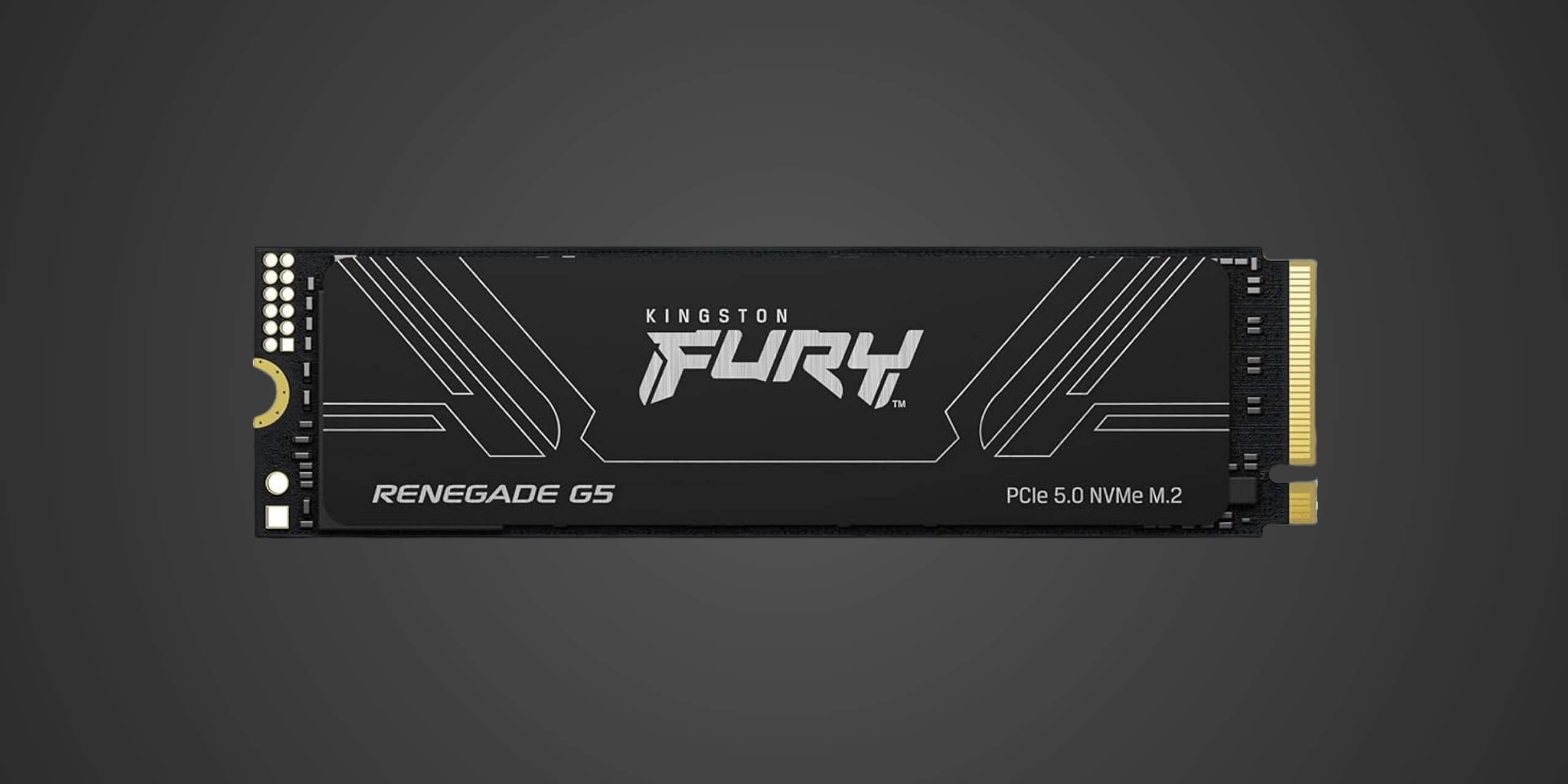
Table of Contents
Introduction
If you've been hunting for a PCIe Gen 4.0 NVMe SSD that doesn't demand a mortgage payment, you've probably already bumped into Kingston's pricing strategy—and it's refreshingly aggressive. The Kingston FURY Renegade arrives as Kingston's answer to the premium pricing stranglehold that Samsung and Western Digital have maintained over the high-performance SSD market, offering speeds that compete directly with the Samsung 990 Pro and WD_BLACK SN850X while undercutting both on price by meaningful margins.
This M.2 2280 PCIe Gen 4.0 x4 NVMe drive leverages the proven Phison E18 controller paired with Micron's 176-layer 3D TLC NAND to deliver sequential speeds up to 7,300MB/s read and 7,000MB/s write—specifications that place it squarely in the top tier of Gen 4 performance. Available in capacities from 500GB to 4TB, the FURY Renegade targets PC builders, gamers, and PS5 owners who refuse to accept that blistering storage performance should cost double what similar specifications command. Kingston offers the drive in two configurations: a standard version with a low-profile graphene aluminum heat spreader and a heatsink variant explicitly designed for PlayStation 5 installation, with the latter adding roughly ten dollars to the asking price.
Product Overview
The Kingston FURY Renegade is built around the Phison PS5018-E18 controller, which is the same eight-channel PCIe 4.0 controller that powered many of the fastest Gen 4 drives when it launched in 2021. This isn't just any Phison controller slapped into an M.2 form factor—it's specifically engineered with DRAM cache allocation of 1GB per terabyte of storage, ensuring that random access performance remains snappy even when the drive is handling multiple concurrent operations. The controller manages Micron's 176-layer B47R 3D TLC NAND, a combination that has proven itself reliable across multiple drive generations from various manufacturers.
Measuring the standard M.2 2280 form factor at 80mm x 22mm x 2.3mm, the FURY Renegade is roughly the length of a standard credit card and about as thick as three stacked quarters. Kingston wraps this in a slim graphene aluminum heat spreader with a minimalist black aesthetic featuring subtle white FURY branding—a departure from the aggressive gamer styling that dominated their earlier product lines. The single-sided design at 500GB, 1TB, and 2TB capacities means the drive fits in gaming laptops and the PlayStation 5's M.2 slot without clearance concerns, though the 4TB model switches to double-sided construction.
The heatsink variant adds an additional aluminum cooling solution that increases overall thickness to approximately 11.25mm, making it ideal for desktop motherboards with integrated M.2 heatsink covers and perfect for PS5 installation where Sony mandates thermal management. This heatsink model arrives ready to install in Sony's console without requiring any additional cooling purchases—a practical consideration that saves both money and installation headaches.
Kingston backs the FURY Renegade with a five-year limited warranty based on either time elapsed or percentage used as tracked through Kingston's SSD Manager software. Endurance ratings are exceptionally generous for a consumer drive: 500GB models are rated at 500TB written, 1TB at 1,000TB, 2TB at 2,000TB, and the massive 4TB version at 4,000TB. These TBW figures significantly exceed what Samsung offers with the 990 Pro at comparable capacities—the 2TB FURY Renegade delivers 2PBW compared to the 990 Pro's 1.2PBW, providing substantially better long-term durability on paper.
Performance & Real World Speed
Kingston claims sequential speeds up to 7,300MB/s read and variable write speeds depending on capacity—7,000MB/s for the 2TB and 4TB models, 6,000MB/s for 1TB, and 3,900MB/s for the 500GB variant. Random performance reaches up to 1,000,000 IOPS for reads and writes at the higher capacities, which translates to responsive application launches and smooth multitasking when running multiple demanding programs simultaneously.
In real-world testing conducted by multiple reviewers, the FURY Renegade delivers on these promises with remarkable consistency. Sequential read speeds routinely hit 6,900-7,100MB/s in CrystalDiskMark testing, with writes achieving 6,700-6,900MB/s on the 2TB model—falling slightly short of Kingston's claimed maximums but easily competing with the fastest Gen 4 drives available. What matters more for everyday use is random 4K performance at low queue depths, where the drive posts around 80-85MB/s reads and 240-260MB/s writes, numbers that feel snappy during actual computing tasks like launching applications, opening documents, and loading game levels.
Game loading presents an interesting case study. Transferring a 45GB installation of Fortnite from a SATA SSD to the FURY Renegade completes in approximately 85 seconds, while an 80GB copy of a modern AAA title finishes in roughly 2 minutes and 20 seconds—sustained speeds hovering around 3,300-3,500MB/s during large sequential writes. Boot times for demanding games show minimal differences compared to the Samsung 990 Pro, with most titles launching within a second or two of Samsung's flagship—differences that remain imperceptible during normal gameplay.
The drive's pseudo-SLC cache, which Kingston sizes at approximately 369GB on the 1TB model, handles bursty workloads exceptionally well. Writing data within the cache boundary maintains those blistering 6,700MB/s speeds, but once the cache fills during sustained transfers exceeding 300GB, write speeds settle to around 2,000MB/s—respectable for TLC NAND but noticeably slower than drives implementing more sophisticated cache algorithms like the Samsung 990 Pro or WD_BLACK SN850X. For most users who rarely write hundreds of gigabytes in a single session, this cache saturation behavior remains theoretical rather than practical.
Build Quality & Durability
Kingston's FURY branding brings a more mature aesthetic compared to their HyperX gaming heritage, and the Renegade reflects this evolution. The graphene aluminum heat spreader feels substantial rather than cosmetic, providing genuine thermal dissipation that keeps the drive operating within safe temperature ranges even during extended load. The spreader's matte black finish resists fingerprints and scratches, while the white FURY lettering adds just enough visual interest without crossing into RGB territory.
Manufacturing quality inspires confidence—the PCB exhibits tight tolerances with clean solder joints and precise component placement visible through the semi-transparent heat spreader edges. The M.2 connector slides smoothly into motherboard slots without requiring excessive force, and the single screw mounting point aligns perfectly without the fitment issues that occasionally plague lesser drives.
The optional heatsink variant deserves particular attention for its thoughtful engineering. Rather than simply bolting on a generic aluminum block, Kingston designed the heatsink with fins that maximize surface area while maintaining the height requirements Sony specifies for PS5 compatibility. The thermal pad between the drive and heatsink makes full contact across the controller and NAND chips, ensuring efficient heat transfer that prevents thermal throttling during the extended gaming sessions that PS5 owners frequently enjoy.
Durability extends beyond physical construction to the endurance specifications. That 2PBW rating on the 2TB model translates to writing the entire capacity 1,000 times before reaching the warranty limit—a threshold that even video editors working with 4K footage would struggle to hit within five years. Kingston's established reputation in the memory and storage industry adds another layer of confidence, as they've been manufacturing these components since many of their competitors were still figuring out DRAM.
Compatibility
The Kingston FURY Renegade is a universal M.2 2280 PCIe Gen 4.0 x4 NVMe SSD that works with any system featuring a compatible M.2 slot. This means desktop motherboards from roughly 2019 onwards supporting AMD Ryzen 3000 series or Intel 10th generation and newer processors, gaming laptops with M.2 slots, and crucially, both Sony's PlayStation 5 and PlayStation 5 Slim when using the heatsink variant.
Installation in desktop PCs is straightforward—slot the drive into any available M.2 socket, secure it with the included screw or your motherboard's tool-less mechanism, and initialize it through your operating system's disk management utility. The drive operates at full PCIe 4.0 speeds when installed in a Gen 4 slot, and gracefully falls back to Gen 3 speeds when used in older systems—you won't break anything by installing it in a Gen 3 motherboard, you'll simply be limited to that interface's maximum throughput of around 3,500MB/s.
For PlayStation 5 owners, the heatsink model specifically meets Sony's requirements for M.2 expansion storage. The PS5 mandates drives with read speeds of at least 5,500MB/s and a heatsink to prevent thermal issues inside the console's confined space—the FURY Renegade with heatsink satisfies both requirements out of the box. Installation involves removing the PS5's side panel, unscrewing the M.2 expansion bay cover, inserting the drive, and securing it with the adjustable standoff—the entire process takes roughly ten minutes and requires only a Phillips head screwdriver. Once installed, PS5 games can be stored and played directly from the FURY Renegade with load times that often match or exceed the console's internal SSD.
The standard heat spreader model technically works in the PS5, but Kingston and Sony both recommend using the heatsink version to ensure adequate cooling. Desktop users with motherboards featuring integrated M.2 heatsink covers can save the premium and opt for the standard version, as those motherboard heatsinks provide equivalent or superior cooling.
Critically, you need to understand what this drive can and cannot do. The FURY Renegade works with Windows 10, Windows 11, Linux distributions, and macOS systems that support NVMe storage. It supports TRIM for maintaining long-term performance, but it does not include hardware encryption like Samsung's drives—if you require encrypted storage, you'll need to implement software encryption through your operating system or look at enterprise-class alternatives.
Strengths & Weaknesses
The Kingston FURY Renegade's greatest strength lies in its exceptional value proposition—delivering top-tier Gen 4 performance at pricing that consistently undercuts its primary competitors. When the 2TB heatsink model retails for $170-190 while the Samsung 990 Pro equivalent hovers around $200-220, that $30-50 difference represents meaningful savings, especially when you're not sacrificing performance in any measurable way during real-world use. Sequential speeds within 3-5 percent of the fastest Gen 4 drives available translate to identical subjective performance when launching games, loading applications, or transferring large files.
The endurance specifications deserve recognition as genuinely impressive rather than merely adequate. That 2,000TB TBW rating on the 2TB model isn't just marketing fluff—it reflects Kingston's confidence in the Micron NAND and Phison controller combination to handle sustained write workloads over the drive's lifespan. Video editors, content creators, and users who regularly write large amounts of data will appreciate this generous endurance allowance, as it eliminates concerns about prematurely wearing out the drive through normal use.
PS5 compatibility with the heatsink model removes friction from the installation process, a thoughtful touch that competing manufacturers sometimes overlook. The fact that you can purchase the FURY Renegade heatsink version and install it in your PS5 without buying additional cooling or worrying about clearance issues makes the upgrade process accessible to users who might otherwise hesitate to open their console.
However, the FURY Renegade isn't without notable limitations. The drive's thermal management, while adequate with the heatsink or proper airflow, shows its age during sustained heavy workloads. Testing reveals the drive climbing to 75-80°C during extended sequential writes exceeding 1TB, at which point performance begins tapering to prevent overheating. This throttling behavior is manageable—the drive doesn't crash or corrupt data—but newer drives like the Samsung 990 Pro and Solidigm P44 Pro implement more sophisticated thermal algorithms that maintain more consistent performance under extreme loads.
Cache saturation behavior after writing approximately 300GB represents the drive's most significant performance compromise. Once you exceed the pseudo-SLC cache, write speeds plummet from 6,700MB/s to around 2,000MB/s, a degradation that's noticeable during massive file transfers. To be fair, most consumer workloads never approach these conditions—you'd need to be copying entire game libraries or processing dozens of gigabytes of 4K video footage in a single session to encounter this limitation. Nevertheless, drives implementing dynamic cache strategies like the WD_BLACK SN850X maintain more consistent sustained write performance across varied workloads.
Random 4K performance at low queue depths trails the absolute best Gen 4 drives by 15-20 percent in synthetic benchmarks, a deficit that the Samsung 990 Pro exploits with its newer controller technology. While this gap exists on paper, the practical impact remains minimal—you're talking about differences of 10-15 milliseconds during application launches, imperceptible to human perception. Still, if you're seeking every last fraction of responsiveness and budget isn't a constraint, Samsung's flagship edges ahead.
Verdict: Should You Buy It?
Buy this if:
- You're building or upgrading a gaming PC and want top-tier Gen 4 performance without paying the Samsung tax
- You own a PlayStation 5 and need reliable expansion storage that matches the console's internal SSD speeds without breaking the bank
- You value exceptional endurance ratings and Kingston's established warranty support over marginal synthetic benchmark advantages
- You're a content creator working with large media files who needs both capacity and speed at reasonable pricing
- You're shopping during sales when the FURY Renegade's already competitive pricing drops even further below competing drives from Samsung and Western Digital
Skip this if:
- You're building a cutting-edge system around PCIe Gen 5.0 and want to future-proof with the latest interface standards even though few applications currently benefit from Gen 5 speeds
- You regularly perform sustained sequential writes exceeding several hundred gigabytes and need absolute consistency across marathon transfer sessions
- You require hardware encryption for sensitive data and cannot implement software-based alternatives
- You've already invested in a Samsung or Western Digital ecosystem and value the brand-specific management software features those manufacturers provide
- You're only running a single game at a time and a cheaper Gen 3 drive would serve your actual needs without any perceptible performance difference