Crucial T705
Speed You Can't Use Yet
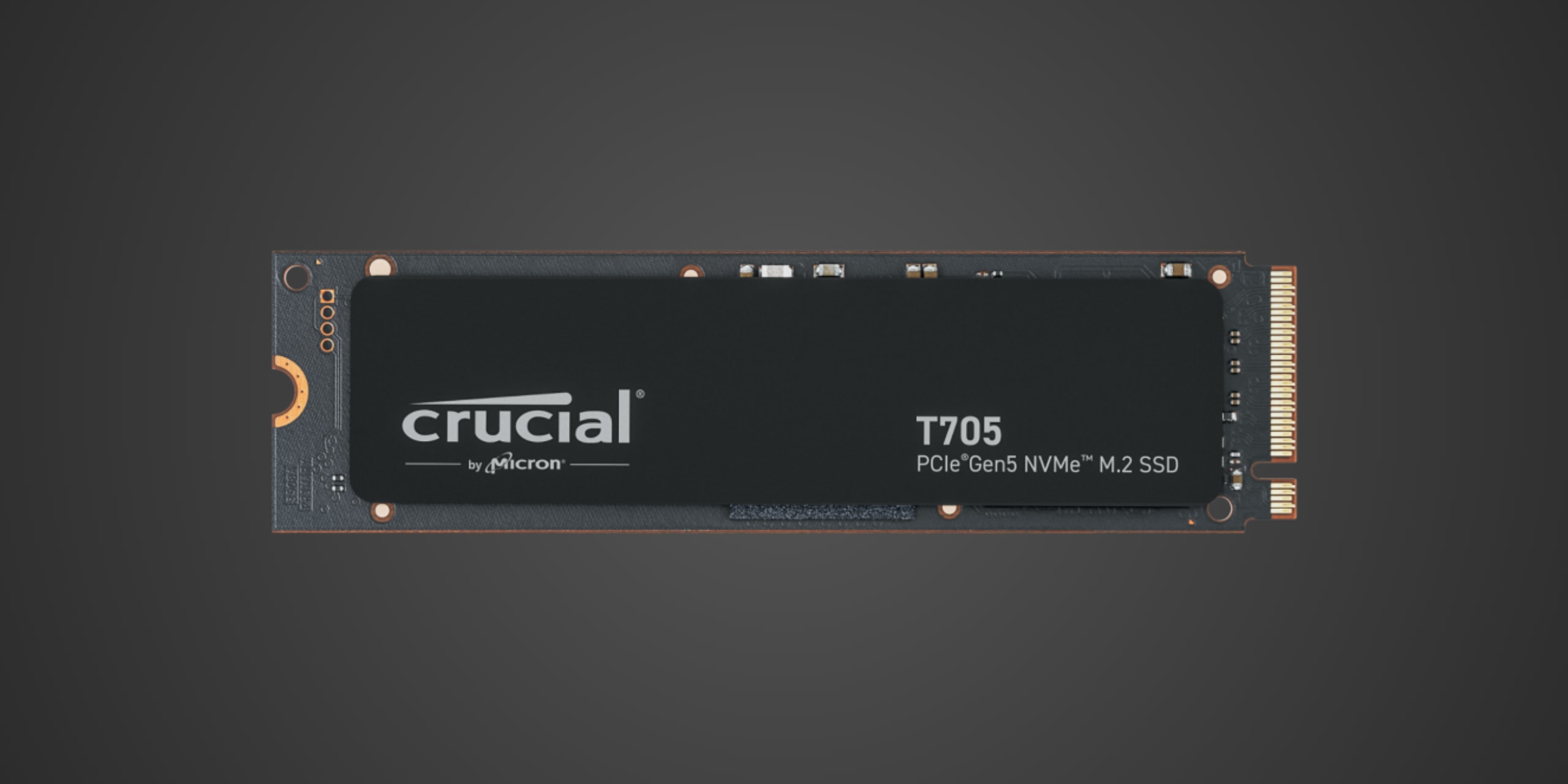
Table of Contents
Introduction
If you've been building or upgrading high-end PCs lately, you've probably already bumped into the existential question haunting every enthusiast: do you actually need PCIe Gen5 storage? Crucial arrives with the T705 as its answer to this universal debate—a drive that pushes the absolute bleeding edge of what's physically possible with current SSD technology while simultaneously making you question whether any of it matters for your actual workload. This officially licensed PCIe Gen5 NVMe solution leverages Phison's E26 controller paired with Micron's latest B58R 232-layer TLC NAND to deliver sequential read speeds up to 14,500 MB/s and writes hitting 12,700 MB/s, numbers that would have seemed like science fiction just a few years ago. Available in 1TB, 2TB, and 4TB capacities with optional heatsinks that are frankly massive, the T705 targets enthusiasts and professionals who refuse to settle for anything less than chart-topping benchmark numbers—even if those numbers don't always translate to perceptible real-world improvements over far cheaper PCIe Gen4 alternatives.
Product Overview
The Crucial T705 is built around Phison's proven E26 controller paired with Micron's B58R FortisFlash TLC NAND, which is essentially the same hardware foundation as its T700 predecessor but with faster 2000 MT/s NAND speeds instead of 1600 MT/s. This isn't just any M.2 drive slapped into the standard 2280 form factor—it's specifically engineered to extract every possible drop of performance from the PCIe 5.0 x4 interface, which provides a theoretical maximum bandwidth of up to 32 GB/s compared to Gen4's 16 GB/s ceiling.
The drive measures the standard M.2 2280 dimensions at 80mm x 22mm, roughly the size of a stick of gum but significantly thinner when bare. Crucial wraps this silicon in two distinct packages—a bare drive variant for those who already have motherboard heatsinks or want minimal clearance, and a heatsink version that's absolutely enormous, adding substantial height and width to accommodate serious cooling requirements. The heatsink variant is necessary because Gen5 drives run substantially hotter than their Gen4 counterparts, and without proper thermal management, the T705 will throttle performance to protect itself from damage.
Weight for the bare drive sits around 7 grams, light enough to forget it exists once installed, while the heatsink version balloons to roughly 50 grams thanks to the chunky aluminum cooling apparatus. Crucial's aesthetic here is understated for the bare version—just a simple black PCB with minimal branding—while the heatsink models sport their industrial-looking aluminum fins that scream "high-performance hardware" to anyone who bothers looking inside your case.
The drive ships with Acronis True Image cloning software and a one-month Adobe Creative Cloud All Apps subscription, which feels like Crucial throwing in everything they can to justify the premium pricing. More importantly, it comes with a five-year warranty and endurance ratings of 600 TBW for the 1TB model, 1200 TBW for 2TB, and 2400 TBW for the 4TB variant—respectable numbers that suggest Micron has confidence in their NAND longevity even when pushed to these extreme speeds.
Available capacities launched simultaneously at 1TB, 2TB, and 4TB, giving buyers options from the start rather than the staggered releases that plague some manufacturers. Each capacity tier is available both bare and with heatsink, providing six total SKUs to choose from depending on your cooling solution and budget tolerance.
Performance & Real World Speed
Crucial claims sequential read speeds up to 14,500 MB/s on the 2TB and 4TB models with the 1TB variant hitting 13,600 MB/s, while write speeds reach up to 12,700 MB/s for the larger capacities and 10,000 MB/s for the 1TB drive. These are genuinely impressive numbers that represent the current pinnacle of retail SSD performance, and in controlled benchmark testing, the T705 actually delivers on these promises rather than falling short like some competitors.
In real-world testing conducted by multiple reviewers, the T705 achieved sequential read speeds around 14,163 MB/s in CrystalDiskMark at queue depth 8, essentially matching its advertised ceiling. Sequential writes hit approximately 12,653 MB/s under similar conditions—again, right where Crucial promised they'd land. These speeds absolutely demolish PCIe Gen4 drives like the Samsung 990 Pro, which tops out around 7,153 MB/s reads and 6,820 MB/s writes, making the T705 roughly 98 percent faster in sequential read performance and 85 percent faster in sequential writes.
But here's where reality intrudes on the benchmark party—those massive sequential numbers rarely translate to proportional real-world improvements for typical users. PCMark 10's storage benchmark, which simulates actual application workloads including Windows boot, game loading, and file transfers, showed the T705 scoring 5,654 points compared to the T700's 5,151—a measurable 9.7 percent improvement but hardly revolutionary. Moving to the data drive benchmark test revealed a more substantial 12.8 percent gain with the T705 hitting 12,128 versus the T700's 10,750, but even here we're talking about differences measured in milliseconds during application launches rather than seconds.
File transfer testing revealed sustained speeds around 3,920 MB/s when moving large movie files, while folders packed with RAW photos and documents showed similar throughput. These are genuinely fast numbers that mean copying 100GB of data takes roughly 26 seconds instead of the 40-50 seconds you'd see on a high-end Gen4 drive—noticeable if you're constantly shuffling massive files around, essentially imperceptible if you're just installing games and launching applications.
Random 4K performance at queue depth 1—arguably the most relevant metric for typical desktop responsiveness—showed the T705 performing well but not dramatically ahead of quality Gen4 alternatives. The drive hit around 1.02 million IOPS for random reads with 124.7 microsecond latency, strong numbers that place it near the top of the charts but not miles ahead of competitors. Random write performance landed at 256K IOPS with 72.5 microsecond latency, solid but actually trailing the Samsung 990 Pro in this specific metric.
Gaming performance via 3DMark's storage benchmark showed the T705 scoring 6,739 points with 1,126 MB/s bandwidth and 26 microsecond latency, approximately 40 percent ahead of the 990 Pro's 4,816 points—impressive on paper but translating to game load time differences measured in fractions of a second rather than noticeable delays. DirectStorage API support promises future improvements, but as of now, virtually no games actually leverage this technology in ways that benefit from Gen5 speeds over Gen4.
Build Quality & Durability
Crucial has always approached product design with understated pragmatism rather than flashy gamer aesthetics, and the T705 continues this tradition. The bare drive features a simple black PCB with minimal branding, single-sided component placement that ensures compatibility with tight spaces, and build quality that feels solid despite weighing almost nothing. The components are neatly arranged, the solder work looks clean, and the overall impression is of a drive built to specification rather than built to impress.
The heatsink variant is where things get substantial—and by substantial, we mean genuinely massive compared to typical M.2 cooling solutions. The aluminum heatsink adds considerable bulk with tall fins designed to maximize surface area for heat dissipation, necessary because Gen5 drives generate significantly more heat than their Gen4 counterparts during sustained workloads. Under typical conditions with proper airflow, Crucial claims this heatsink allows the T705 to run at maximum workload without thermal throttling, and real-world testing generally confirms this assertion—though "proper airflow" is doing a lot of work in that sentence since inadequate case ventilation will absolutely cause performance degradation.
The heatsink attaches to the drive with what appears to be high-quality thermal tape or pad, ensuring good contact between the NAND, controller, and cooling apparatus. Build quality here inspires confidence with tight tolerances and a finish that won't degrade quickly, though the sheer size means you'll need to verify clearance in your particular motherboard and case combination since some configurations simply won't accommodate the added height.
Installation is straightforward on bare drives—standard M.2 mounting with a single retention screw—while heatsink models require a bit more care during installation to avoid damaging the cooling apparatus or scraping against adjacent components. The drive's single-sided design helps here since you don't need to worry about components on the back interfering with motherboard standoffs or heatsinks.
Crucial backs the T705 with a five-year warranty, matching or exceeding most competitors and serving as a confidence signal that Micron expects these drives to survive well beyond typical upgrade cycles. The endurance ratings of 600 TBW for 1TB, 1200 TBW for 2TB, and 2400 TBW for 4TB represent solid specifications that most users will never approach even with heavy daily use—you'd need to write approximately 328GB per day every single day for five years to exhaust the 1TB model's endurance rating.
Compatibility
The Crucial T705 is specifically designed for desktop PCs with PCIe Gen5 M.2 slots, which currently means recent motherboards built around Intel's 13th/14th generation Core processors or AMD's Ryzen 7000 series chips. This is PCIe Gen5 NVMe storage that demands a Gen5 slot to deliver its advertised performance, period.
Critically, you need to understand what this drive can and cannot do. The T705 will absolutely work in PCIe Gen4 and even Gen3 slots thanks to backward compatibility, but it will operate at whatever speed your slot supports—meaning you'll get Gen4 performance in a Gen4 slot and Gen3 performance in a Gen3 slot, completely negating the premium you paid for Gen5 speeds. Real-world testing showed the T705 still performs admirably when limited to Gen4 bandwidth, essentially matching quality Gen4 drives, but there's zero rational reason to pay Gen5 prices for Gen4 performance when alternatives like the Samsung 990 Pro or Crucial's own T500 cost substantially less.
Installation requires a standard M.2 2280 slot on your motherboard, and if you're buying the bare version, you absolutely must install it with either your motherboard's integrated M.2 heatsink or an aftermarket cooling solution. Running the T705 without cooling is asking for thermal throttling and potential performance degradation—this isn't optional cooling for marginal gains, it's mandatory cooling to prevent the drive from protecting itself by slowing down.
The heatsink version assumes you have clearance in your case and that no other components will interfere with its substantial bulk. Some motherboards place M.2 slots directly under graphics cards or near cable routing areas where the T705's heatsink simply won't fit, so measure your available space before committing to the heatsink model. The bare version gives you flexibility but requires you to source your own cooling solution.
The T705 works with Windows 10, Windows 11, and modern Linux distributions without requiring special drivers—the operating system's native NVMe drivers handle everything. macOS compatibility exists if you're building a Hackintosh, though Apple's lack of official PCIe Gen5 support means you won't see any benefits over Gen4 speeds even if the drive physically works.
For PS5 owners hoping to use this as expansion storage, you technically can since the PS5 accepts M.2 NVMe drives, but you're wildly overpaying for performance the console cannot utilize—Sony's requirements top out at PCIe Gen4 speeds with 5,500 MB/s minimums, making the T705's Gen5 capabilities entirely wasted. Buy a Gen4 drive instead and save your money.
The T705 is absolutely not compatible with laptops lacking M.2 slots, external enclosures not designed for NVMe drives, or any SATA-based systems. This is cutting-edge internal storage for desktop PCs with modern platforms, and attempting to use it elsewhere ranges from wasteful to physically impossible.
Strengths & Weaknesses
The T705's greatest strength lies in its absolutely dominant synthetic benchmark performance—this is genuinely the fastest retail SSD you can buy right now by pure throughput numbers. Sequential read speeds pushing 14,500 MB/s and writes hitting 12,700 MB/s represent the current technological ceiling for consumer storage, and if your workflow involves constantly moving hundreds of gigabytes of data, those speeds translate to measurable time savings that add up across days and weeks of work. The drive's random performance is also strong with over 1 million IOPS in reads, ensuring responsive behavior during typical desktop tasks even when the drive is under load.
Crucial's inclusion of both bare and heatsink variants at launch provides genuine flexibility for different build requirements. The bare drive works perfectly if you've got a motherboard with integrated M.2 cooling, while the heatsink version offers peace of mind for users without existing thermal solutions—though that heatsink is genuinely enormous and requires careful fitment verification. The five-year warranty and high endurance ratings inspire confidence that this drive will outlast typical upgrade cycles, and the bundled Acronis cloning software actually proves useful when migrating from existing storage rather than forcing you to hunt down third-party solutions.
DirectStorage API optimization promises future benefits as games and applications adopt this technology, potentially giving the T705 longevity advantages over Gen4 drives when software finally catches up to hardware capabilities. The drive also performs admirably even when limited to PCIe Gen4 bandwidth, essentially matching quality Gen4 competitors when used in older motherboards—wasteful from a cost perspective but at least functional.
However, the T705 isn't without notable limitations that seriously undermine its value proposition for most users. The fundamental weakness affecting this drive—and frankly all Gen5 SSDs at current pricing—is cost when compared to mature Gen4 alternatives that deliver 90 percent of the real-world performance for 40-60 percent of the price. A 1TB T705 typically costs $155-180 depending on sales, while the excellent Samsung 990 Pro Gen4 drive runs $110-130 for the same capacity and the Crucial T500 Gen4 option sits around $80-100. You're paying double the per-gigabyte cost for benchmark wins that rarely translate to perceptible improvements in actual application loading, game launches, or system responsiveness.
The counterargument, of course, is that early adopters always pay premiums for cutting-edge technology and that Gen5 prices will fall as manufacturing scales, but value-seekers will still balk at current pricing when Gen4 drives provide essentially indistinguishable day-to-day performance. Gaming specifically sees minimal benefit—3DMark storage benchmark improvements don't overcome the reality that game engines aren't bottlenecked by Gen4 SSD speeds, making the T705's advantages purely academic for most gamers.
Thermal requirements present another practical limitation since the T705 demands active cooling to avoid throttling, unlike many Gen4 drives that run cool enough with passive heatsinks or even bare. The heatsink version addresses this but adds substantial bulk that creates fitment challenges, while the bare version assumes you have adequate motherboard cooling or plan to add aftermarket solutions. Power consumption also runs higher than Gen4 alternatives, potentially relevant for users concerned about efficiency or running many drives simultaneously.
Platform requirements limit the addressable market since you genuinely need a PCIe Gen5-capable motherboard to justify the purchase, eliminating anyone running Intel 12th gen or earlier, AMD Ryzen 5000 or earlier, or planning builds on budget platforms that skimp on Gen5 M.2 slots. The lack of 8TB capacity options disappoints users seeking maximum storage density, though frankly at current Gen5 pricing an 8TB model would cost somewhere north of $900 and price itself out of all but the most extreme professional workstations.
Verdict: Should You Buy It?
Buy this if:
- You're building or upgrading a high-end desktop PC with Intel 13th/14th gen or AMD Ryzen 7000 series platform that includes PCIe Gen 5 M.2 slots
- Your workflow genuinely involves moving massive files regularly enough that sequential transfer speeds measurably impact your productivity such as 8K video editing or large dataset analysis
- You want absolute bragging rights for benchmark numbers and don't mind paying premium prices for theoretical performance advantages
- You're future-proofing for DirectStorage API adoption in upcoming games and applications
- You've found the drive on sale at prices approaching Gen 4 alternatives which occasionally happens during aggressive promotions
Skip this if:
- You're primarily gaming and don't care about benchmark screenshots since game load time differences between Gen 5 and quality Gen 4 drives measure in fractions of seconds rather than noticeable delays
- Your motherboard only supports PCIe Gen 4 or earlier making the Gen 5 premium completely wasted
- You're budget-conscious and can buy two Gen 4 drives for similar total cost while getting more usable capacity
- Your workflow involves typical productivity tasks like web browsing and office applications where even SATA SSDs provide adequate responsiveness
- You're building in a compact case or motherboard configuration where the massive heatsink won't fit and adequate alternative cooling isn't available
- You simply want the best value for money since mature Gen 4 options like the Samsung 990 Pro or Crucial's own T500 deliver 90% of real-world performance for 40-60% of the cost